
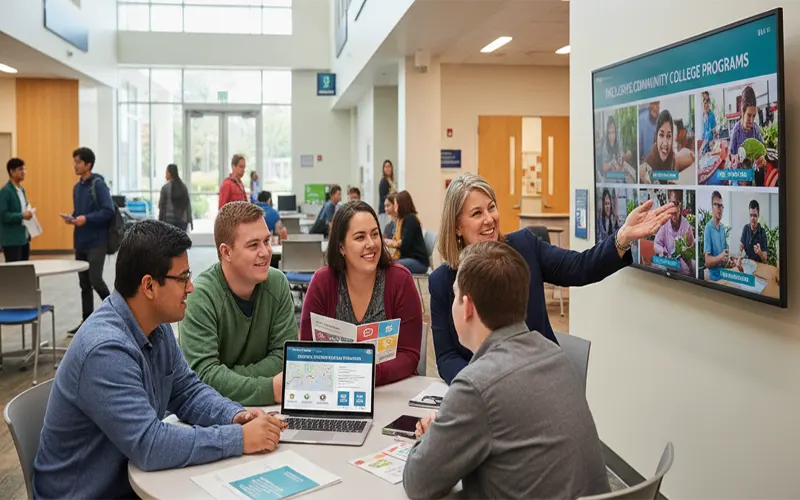
In 2026, the dream of “going to college” is no longer a restricted path for students with intellectual disabilities (ID). The landscape has shifted from a “medical model” of care to an Inclusive Postsecondary Education (IPSE) model, which views disability as a natural part of human diversity.
For adults with ID, community colleges now serve as the primary gateway to independence, social capital, and meaningful employment. However, not all “disability programs” are created equal. Finding a program that offers true inclusion rather than mere “segregation in a basement” requires a strategic, data-driven approach.
1. The Search Strategy: The “Think College” Framework
The most important tool in your arsenal is Think College, the national coordinating center for inclusive higher education. In 2026, the “Think College National Search Tool” has become the industry standard for vetting programs.
- Filter for CTP Programs: Your first step is to filter your search for Comprehensive Transition and Postsecondary (CTP) programs. This is a federal designation from the U.S. Department of Education.
- The Funding Connection: CTP status is vital because it allows students with ID to access federal financial aid, such as Pell Grants, even if they are not pursuing a traditional degree. Without CTP status, families often have to pay 100% out-of-pocket.
2. Evaluating Program Quality: The Four Pillars
A high-quality program doesn’t just provide “something to do” during the day; it provides a pathway to a life of the student’s choosing. Evaluate every potential community college program against these four pillars:
Pillar 1: Academic Inclusion
Does the student sit in the same classrooms as their neurotypical peers? A gold-standard program uses Universal Design for Learning (UDL), allowing students to “audit” classes like Graphic Design, Early Childhood Education, or Automotive Tech while receiving modified assignments that match their cognitive level.
Pillar 2: Integrated Vocational Training
Employment is the ultimate goal. Look for programs that offer Integrated Competitive Employment. This means the student isn’t just “volunteering”; they are participating in internships on or off-campus that lead to a recognized credential or a “Certificate of Completion” that local employers respect.
Pillar 3: Social Equity and Peer Mentorship
Inclusion is about more than just academics; it’s about belonging. The best programs utilize Peer Mentors—fellow college students who act as “buddies” for lunch, gym sessions, or joining campus clubs.
The Litmus Test: Ask if students in the program can join the same intramural sports teams, Greek life, or student government as everyone else. If the answer is “we have our own separate club,” it’s not fully inclusive.
Pillar 4: Independent Living and Self-Advocacy
Since community colleges are typically “commuter” schools, the focus should be on Self-Determination. Does the curriculum teach the student how to navigate public transit, manage an ABLE Account (529A), and lead their own “Person-Centered Planning” meetings?
3. The 2026 Application Process
Applying to an IPSE program is different from the traditional “Common App” process.
- No SAT/ACT Required: Almost all inclusive programs have waived standardized testing in favor of Person-Centered Planning (PCP).
- The Interview: Admissions teams are looking for “willingness to grow” and “desire for independence.” The student—not the parent—should be the primary voice during the interview.
4. Comparison Checklist for Programs
| Feature | Green Flag (Inclusive) | Red Flag (Segregated) |
| Location | Integrated throughout campus buildings. | One specific room in the basement or “annex.” |
| Curriculum | Students choose their own “Audit” classes. | “Life Skills” classes with only other ID students. |
| Peer Contact | Constant interaction with typical peers. | Students only interact with staff or “special” tutors. |
| Credential | Leads to a specific Vocational Certificate. | Only provides a “Certificate of Attendance.” |
5. Funding the Dream: Financial Options in 2026
The cost of these programs can be daunting, but several 2026 mechanisms exist to lower the barrier:
- Pell Grants: Available only to students in accredited CTP programs.
- ABLE Accounts (529A): Tax-advantaged savings accounts that do not count against asset limits for SSI or Medicaid.
- State Vocational Rehabilitation (VR): Many state VR agencies will pay for a portion of college tuition if it is directly tied to an employment goal.
- Intellectual Disability (ID) Waivers: In some states, Medicaid waiver funds can be used for “Pre-Vocational” training, which may cover certain college program fees.
5 Questions to Ask the Admissions Director
- “Is your program officially recognized by the Department of Education as a CTP?”
- “What percentage of the student’s day is spent in classes with students without disabilities?”
- “How do you train the general faculty to support students who are auditing their courses?”
- “Can you show me the employment data for your graduates from the last two years?”
- “How are peer mentors selected and trained to ensure authentic friendships?”
The “Spiky Profile” of Success
Every adult with an intellectual disability has a “Spiky Profile”—areas where they need significant support and areas where they possess unique brilliance. A community college program should be the place where those peaks are celebrated and those valleys are supported. When you find a program that prioritizes agency over compliance, you haven’t just found a school; you’ve found a launchpad for a self-determined life.