
In the 2026 labor market, “soft skills” have become the primary currency of career longevity. However, for decades, these skills—communication, collaboration, and adaptability—have been defined through a strictly neurotypical lens. For neurodivergent (ND) adults, traditional soft-skill training often feels like an instruction manual for “masking”: a taxing effort to mimic social cues that leads to burnout and high turnover.
To build a truly inclusive workforce, we must move toward Lifelong Learning Modules that are neuro-inclusive by design. These modules don’t seek to “fix” the individual; they seek to bridge the gap between different cognitive styles, viewing neurodivergent traits as professional assets rather than deficits.
1. The “Spiky Profile” and the Soft Skills Gap
The foundation of neuro-inclusive training is understanding the Spiky Profile. Traditional corporate training assumes a “flat” development of skills. In contrast, many autistic or ADHD adults exhibit extreme proficiencies in technical or analytical areas alongside significant challenges in social navigation or executive functioning.
Lifelong learning modules must be “modular” to accommodate this. A worker might skip a module on “Deep Focus” (where they already excel) but spend extra time on a module dedicated to “Managing Sensory Overload.”
2. Module 1: Authentic Communication & The Double Empathy Problem
The most significant barrier in the workplace is the Double Empathy Problem. This theory suggests that communication breakdowns are a two-way street; neurotypical (NT) and neurodivergent (ND) people simply have different social “languages.”
- Explicit over Implicit: This module teaches ND adults (and their managers) to prioritize literal, written, and explicit communication. Instead of trying to “read between the lines,” the goal is to create a culture where “What you say is what you mean.”
- Networking without Masking: Rather than teaching “small talk,” this module focuses on Value-Add Networking—connecting over shared interests or technical problems, which is often more sustainable and authentic for ND professionals.
3. Module 2: Executive Functioning & Self-Regulation
Executive function challenges—such as starting tasks, managing time, or switching focus—can be significant hurdles. Modern modules utilize “body doubling” and “atomic analysis” to solve these.
- Atomic Task Analysis: Breaking a massive project into “atomic” steps to prevent “task paralysis.”
- Energy Accounting: Moving beyond time management to Energy Management. This involves identifying which tasks drain a student’s “social battery” and which ones recharge it, then scheduling the workday accordingly to prevent burnout.
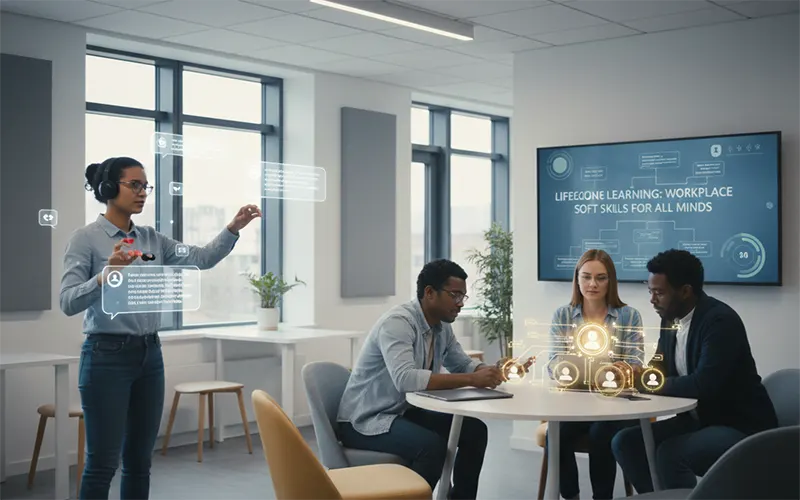
- The Virtual Body Double: In 2026, many modules incorporate AI-powered “co-working” spaces where a digital presence helps the user stay focused on a single task without the pressure of direct social interaction.
Soft Skills: Neurotypical vs. Neurodivergent Perspectives
| Skill Area | Traditional (NT) Expectation | Neuro-Inclusive (ND) Approach |
| Communication | Reading between the lines; eye contact. | Explicit, literal, and written communication. |
| Networking | Small talk and “vibe” checks. | Interest-based connection & “Value-Add.” |
| Time Management | Strict adherence to 9-to-5 “clock time.” | “Energy Accounting” and task-chunking. |
| Adaptability | Effortless transition between tasks. | Planned transitions with clear expectations. |
4. Module 3: Strategic Self-Advocacy
The most important “soft skill” for any ND adult is the ability to advocate for their own support needs. This module focuses on the Agency of the learner.
- The Adjustment Negotiation: Teaching adults how to translate their needs into “business value.” For example: “I am 20% more productive when I work in a low-sensory environment; may I use noise-canceling headphones during deep-work hours?”
- Disclosure Strategy: Providing a framework for if, when, and how to disclose a diagnosis, focusing on the specific accommodations required rather than just a medical label.
5. The Role of Technology in 2026
By 2026, technology has moved from being a distraction to a “cognitive prosthetic.”
- VR Social Simulators: Learners can practice high-stakes conflict resolution or “salary negotiation” in a safe-to-fail virtual environment that provides real-time feedback on tone and clarity.
- AI Social “Translators”: Tools that can scan a vague email from a supervisor and “translate” it into a clear list of actionable steps, removing the anxiety of misinterpretation.
6. The Employer’s Responsibility: A Two-Way Bridge
Modules for neurodivergent adults are only half the equation. For these skills to stick, the workplace environment must also be “neuro-ready.”
- Universal Design for Management: Managers should be trained alongside employees, learning to value “Systemic Thinking” and “Hyper-Focus” as innovative assets rather than “weird” personality traits.
- Feedback Loops: Establishing a regular, low-pressure feedback system where both the employee and manager can discuss what is working in their communication style.
Module Design Checklist (For HR & Designers)
- [ ] Clarity: Is all instructional text literal and free of metaphors?
- [ ] Multimodal: Is there an audio and visual version of every lesson?
- [ ] Safe-to-Fail: Does the module allow for anonymous practice?
- [ ] Relevance: Does the skill directly solve a real-world workplace problem?
Reclaiming the “Soft Skill”
Neurodiversity-affirming soft skill training isn’t about making neurodivergent people “less autistic” or “less ADHD.” It is about giving them the tools to navigate a neurotypical world while maintaining their authentic selves. When we develop these modules, we aren’t just helping ND adults; we are creating a more efficient, direct, and empathetic workplace for everyone. The future of work belongs to the cognitively diverse.