
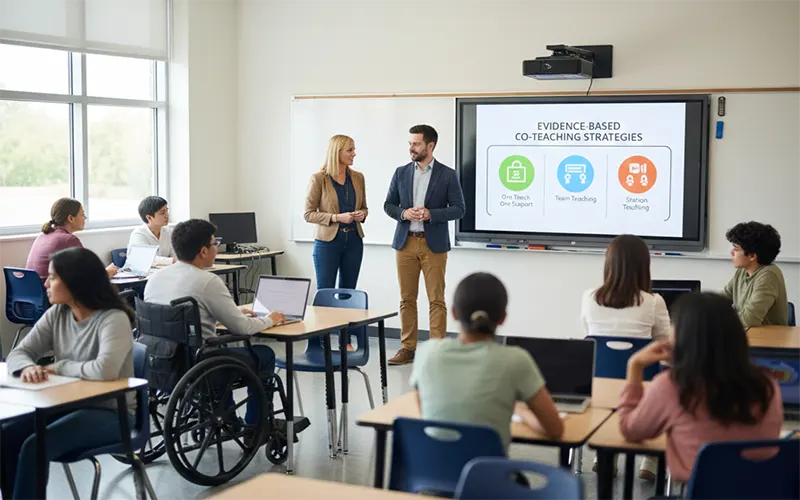
In the high-stakes environment of a 2026 inclusive high school, the “inclusion mandate” has shifted from simply providing access to ensuring instructional mastery for all students. Co-teaching is no longer just “having two adults in the room”; it is a sophisticated professional partnership that requires co-planning, co-instruction, and co-assessment to bridge the gap between rigorous state standards and diverse learner profiles.
For secondary educators, the challenge is unique: teachers must navigate complex disciplinary content (from Organic Chemistry to AP Statistics) while simultaneously addressing a wide range of neurodiverse needs. Success in this context depends on moving beyond the “Velcro assistant” model toward high-leverage practices that ensure Instructional Parity.
1. The High School Co-Teaching Continuum
Effective co-teaching is a cycle. If one teacher is consistently the “lead” while the other “drifts” to manage behavior, the classroom is not truly co-taught. High school students are highly perceptive; they must see both educators as equal authorities to buy into the inclusive culture.
2. The Six Evidence-Based Models: 2026 High School Edition
The most successful co-teaching teams vary their model based on the instructional objective, not just a set weekly schedule.
| Model | Strategic Use Case (High School) | The 2026 “Level Up” |
| Team Teaching | Modeling academic discourse, debates, or multi-perspective analysis. | Teachers model “civil disagreement” on a literary theme to spark critical thinking. |
| Station Teaching | Chunking complex labs or multi-step Algebra problems into digestible “mini-lessons.” | Use a “Digital Station” with AI-adaptive software to free up both teachers for small groups. |
| Parallel Teaching | Decreasing the teacher-student ratio for high-participation Socratic Seminars. | Split the class into two heterogeneous groups to double the “talk time” for every student. |
| Alternative Teaching | “Just-in-Time” pre-teaching of vocabulary or targeted remediation of a missed concept. | One teacher pulls a group of 5 students to pre-teach a physics formula 10 minutes before the main lab. |
| One Teach, One Observe | Collecting specific data for IEP goal tracking or formative assessment. | Use a tablet to record “engagement data” that will inform the next day’s flexible grouping. |
| One Teach, One Assist | (Use Sparingly) Best for checking for understanding during a short direct-instruction burst. | The “assistant” uses a shared digital whiteboard to add real-time visual scaffolds to the lead’s lecture. |
3. High-Leverage Practices (HLPs) in the Secondary Classroom
To make co-teaching “stick” in a content-heavy environment, teams must integrate High-Leverage Practices. These are the “bread and butter” of inclusive education that maximize student growth.
A. Data-Driven Flexible Grouping
In 2026, stations are not permanent “ability tracks.” Instead, teachers use real-time data (from exit tickets or digital polls) to create dynamic stations.
- The Flow: Students rotate from a Teacher-Led Station (intensive instruction) to a Peer-Collaborative Station (social learning) and finally an Independent Application Station.
B. Universal Design for Learning (UDL)
Co-teachers must co-plan for “the margins.” Instead of retrofitting a lesson for a student with an IEP, they build Multiple Means of Representation into the core instruction. For example, during a History lecture, one teacher speaks while the other live-draws a concept map on the interactive board.
4. Overcoming the “Power Dynamic” in High School
A common pitfall in high school is the “Content Expert” vs. “Strategy Expert” divide. The General Education teacher often feels responsible for the pace, while the Special Education teacher focuses on the individuals. To solve this:
- Shared Planning Time: Research shows that 45 minutes of weekly co-planning is the “tipping point” for success.
- The “Invisible Flow”: During a lesson, co-teachers should use “interjection” strategies—where the second teacher adds a clarifying question or a real-world example without interrupting the flow. This models professional collaboration for the students.
5. Administrative & Structural Support
Co-teaching cannot exist in a vacuum. Effective school leaders in 2026 support this model by:
- Common Planning Time: Scheduling co-teachers to have the same prep period.
- Professional Parity: Ensuring both teachers’ names are on the door, the syllabus, and the gradebook.
- Co-Teaching Health Checks: Regular non-evaluative walk-throughs to provide feedback on the “partnership” rather than just the “teaching.”
Co-Teaching Relationship Health Check
- [ ] The “Door” Test: Are both of our names visible to students and parents as “Co-Teachers”?
- [ ] The “Talk” Ratio: In a 60-minute lesson, does the “second” teacher speak for at least 25-30 minutes?
- [ ] The “Planning” Pulse: Did we meet for at least 30 minutes this week to discuss instructional roles, not just behavior?
- [ ] The “Grouping” Goal: Did we use a small-group model (Station, Parallel, or Alternative) at least twice this week?
The Professional Marriage
Co-teaching is often described as a “professional marriage.” It requires trust, vulnerability, and a shared belief that two brains are better than one. In the 2026 high school classroom, this partnership is the most powerful tool we have to ensure that every student—regardless of their starting point—reaches the high expectations of the secondary curriculum.