

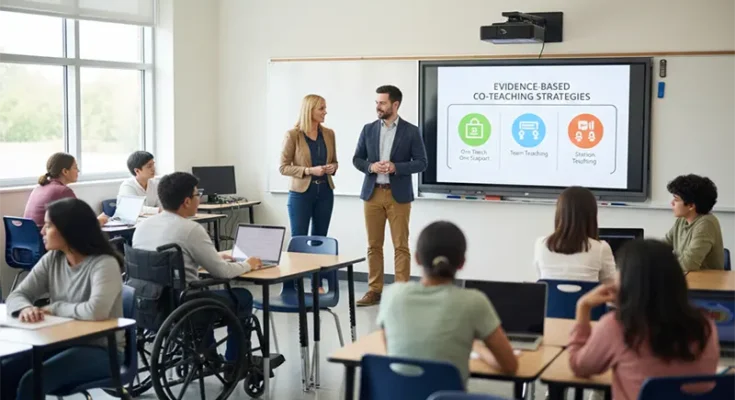
Best Evidence-Based Co-Teaching Strategies for Inclusive High School Classrooms
In the high-stakes environment of a 2026 inclusive high school, the “inclusion mandate” has shifted from simply providing access to ensuring instructional mastery for all students. Co-teaching is no longer just “having two adults in the room”; it is a sophisticated professional partnership that requires co-planning, co-instruction, and co-assessment to bridge the gap between rigorous state standards and diverse learner profiles.
For secondary educators, the challenge is unique: teachers must navigate complex disciplinary content (from Organic Chemistry to AP Statistics) while simultaneously addressing a wide range of neurodiverse needs. Success in this context depends on moving beyond the “Velcro assistant” model toward high-leverage practices that ensure Instructional Parity.
1. The High School Co-Teaching Continuum
Effective co-teaching is a cycle. If one teacher is consistently the “lead” while the other “drifts” to manage behavior, the classroom is not truly co-taught. High school students are highly perceptive; they must see both …
Best Evidence-Based Co-Teaching Strategies for Inclusive High School Classrooms Read More