

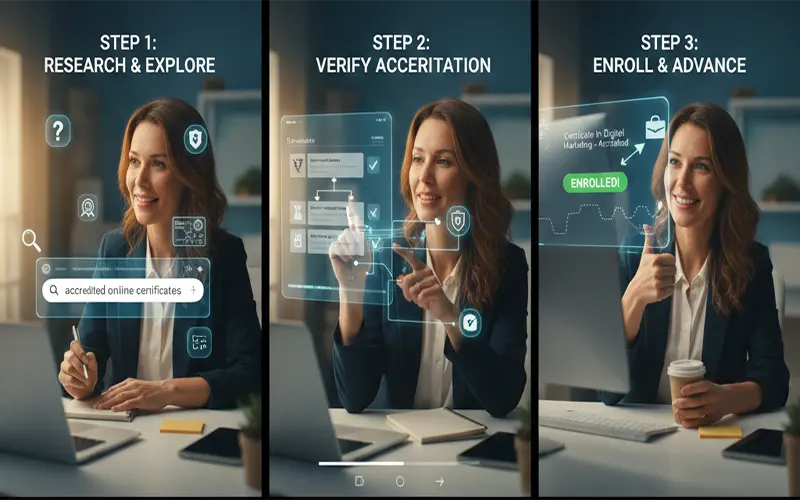
The decision to switch careers is rarely a whim; it is usually a calculated response to a shifting economy. In 2026, the barrier to entry for a new industry is no longer exclusively a four-year degree, but the strategic credential. However, with the explosion of “micro-degrees” and “pro-certificates,” the marketplace has become cluttered. Choosing the wrong program can result in lost time, thousands of dollars in wasted tuition, and a resume that remains ignored by recruiters.
To navigate this, career switchers must treat the selection process like a corporate audit. Here is the step-by-step roadmap to ensuring your online certificate carries the weight you need to land your next role.
Step 1: The Market Audit (Skills over Titles)
Before looking at a single course catalog, you must look at the job descriptions of the role you want. In 2026, specific skills have replaced job titles in importance.
- The Skills Gap Analysis: Go to LinkedIn or specialized job boards and look at 20 “Intermediate” roles in your target field.
- The Frequency Count: Which certifications appear most often in the “Required” or “Preferred” sections? (e.g., Is it the PMP for project management, or the AWS Solutions Architect for cloud roles?)
- The “Proof of Concept”: Identify five professionals on LinkedIn who made the switch you want. Look at their “Licenses & Certifications” section. This is your most reliable data set.
Step 2: Deciphering the Accreditation Code
Accreditation is the only thing standing between a world-class education and a digital “diploma mill.” In 2026, accreditation tells an employer that the program meets a rigorous standard of quality.
- Institutional Accreditation (Regional vs. National): * Regional: Historically considered the “gold standard” for academic rigor. Credits from regionally accredited schools are much easier to transfer if you later pursue a Master’s degree.
- National: Often focuses on vocational or technical schools. While legitimate, some academic institutions may not accept these credits for transfer.
- Programmatic (Specialized) Accreditation: This is the most important for career switchers. It ensures the specific curriculum is industry-vetted.
- Business: Look for AACSB or ACBSP.
- Tech: Look for ABET.
- Healthcare: Look for AHIMA or NCCA-accredited exams.
- Industry-Recognized (Vendor) Credentials: Certificates from Google, AWS, or Microsoft are not “accredited” by academic bodies, but they are highly respected by hiring managers for technical roles.
Red Flags vs. Green Flags: The Selection Table
| Feature | Green Flag (Legitimate) | Red Flag (Potential Scam) |
| Duration | Realistic timeline (3–12 months). | “Get certified in 48 hours.” |
| Pricing | Transparent, per-credit, or flat-fee. | “Aggressive discounts” or hidden fees. |
| Faculty | Industry veterans or PhDs with public bios. | “Anonymous” or “Global Experts” only. |
| Assessment | Portfolio projects and proctored exams. | Attendance-only; easy MCQ quizzes. |
| Reviews | Independent reviews (G2, Trustpilot). | Only “perfect” stories on their own site. |
Step 3: Evaluating the “Hidden” Metrics
A certificate is a bridge to a job. If the bridge doesn’t reach the other side, it’s useless. In 2026, you must evaluate the support infrastructure:
- Career Services: Does the program have a direct pipeline to companies? Ask for their specific “Placement Rate” for career switchers, not just total graduates.
- Stackability: Can these credits “stack” into a future degree? This is vital for long-term ROI.
- The “Proof of Work” Component: Does the curriculum culminate in a Capstone Project? Recruiters today want to see a GitHub repository or a business case study, not just a digital badge.
Step 4: The Financial ROI Analysis
The most expensive certificate isn’t the one with the highest tuition—it’s the one that doesn’t lead to a salary increase.
- The 2x Rule: A certificate should ideally lead to a salary increase that covers the program’s cost within the first 12 months of your new role.
- Opportunity Cost: Consider the time spent. If a 6-month program gets you into a $80k role faster than a 2-year degree, the “cheaper” degree might actually cost you more in lost wages.
Step 5: Verifying Legitimacy
Before you enter your credit card info, perform a final “Gut Check”:
- Check the DAPIP (Database of Accredited Postsecondary Institutions and Programs) to ensure the school is officially recognized by the Department of Education.
- Search for the school name + “scam” or “dissatisfied” to see real student feedback.
- Verify the physical address. Legitimate institutions have a physical headquarters, not just a PO Box.
Your First 90 Days
Choosing the right certificate is only 50% of the battle. Once you enroll, your goal is to be the most active participant. Connect with your instructors on LinkedIn in week one. Join the student Discord. Start building your portfolio immediately. A certificate is a piece of paper; the community and the skills you build around it are the actual career-switchers.